01
Ship design
Build a ship from individual components and connect its power and fluid networks. The layout carries through to the ship's geometry in flight.
 Read updates ↗
A space combat game where you design the ship you fly. Engines, power, cooling, and sensors are simulated individually, alongside the ship's orbit.
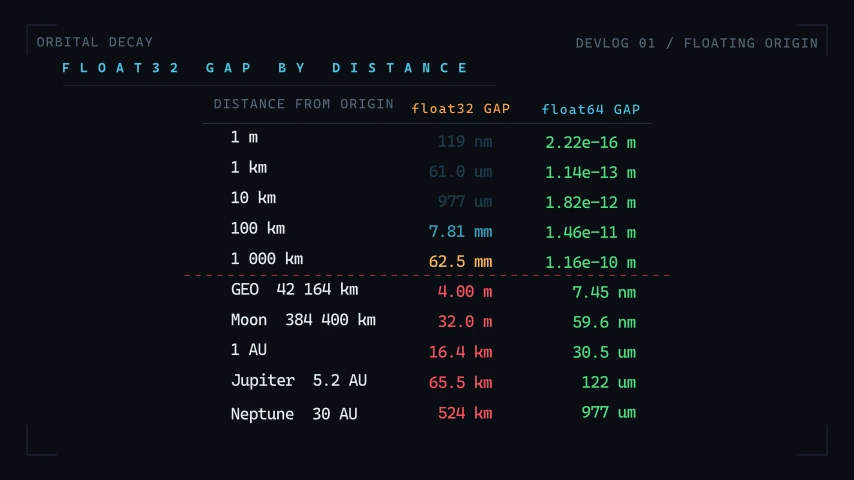
The clips below are diagrams from the floating origin devlog.
Latest updates →I'm Renan Klehm, the developer of Orbital Decay. I'm building it in Unity, with a custom simulation for orbital motion and ship systems. This site is where I'll post development updates and explain how those systems work.
Read the devlogs ↗Build a ship from individual components and connect its power and fluid networks. The layout carries through to the ship's geometry in flight.
Choose a destination orbit or a ship to intercept. The mission planner calculates the required burns and lets you compare departure time, travel time, and propellant cost.
A passive sensor can detect a ship's direction before there's enough information to estimate its orbit. Heat from the hull and engine affects infrared detection, while using radar creates a signal other ships can pick up.
Equipment draws from the power grid and adds heat to coolant loops. Radiators remove that heat, and their temperature affects how much they can reject.
The simulation needs to handle distances across the solar system while the renderer draws small details on a ship. This devlog explains how we keep enough numerical precision for both.
Read the devlog →A diagram showing the separate coordinate systems used by the simulation and the camera.
How the gap between representable numbers grows with distance, comparing 32 bit and 64 bit floats.
How we project distant objects into a finite region around the camera.